Thursday, March 16, 2006

Vocera Communications


"The Vocera Communications System

Enabling instant communication for mobile workers when they need it most.

The Vocera Communications System is a breakthrough wireless platform that provides hands-free, voice communication throughout any 802.11b networked building or campus. Vocera is designed to increase business productivity, teamwork, and customer service levels. The system enables fluid, instant voice conversations among team members, across groups, and throughout an organization of mobile professionals. The Vocera Communications System is made up of two elements: the Vocera System Software and the Vocera Communications Badge."


Steve's Commentary
Take a look at the demo video to get a better picture of how this works. It is a lot like Star Trek communicators.

Monday, March 13, 2006

Dimagi

Dimagi:
"Since its founding in 2002, Dimagi has successfully executed numerous international and domestic public health informatics projects.
Dimagi has a unique approach. We build health systems with patient-level interactions at the core. Each time a patient visits a clinic, we collect information. This influences the actual delivery of health care. To accomplish this, Dimagi's exceptional technical team designs elegant and intuitive interfaces on handhelds, cellular phones and low-cost mini-computers.
From the patient-level databases, we create aggregate databases. This is for monitoring and evaluation purposes and helps organizations manage their health projects and comply with grantor requirements."

Thursday, March 09, 2006

Pink Tentacle


Pink Tentacle
: "
KOTOHANA communicates emotions from afar
Translated by Edo on 2006.03.3 ::: Category: Oh? Wow! Thing!

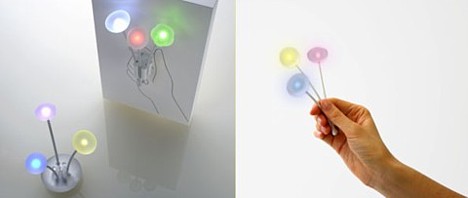
NEC, NEC Design and SGI Japan have teamed up to develop KOTOHANA, flower-shaped terminals that use LED light to remotely communicate human emotions.
Each KOTOHANA set consists two flower-shaped terminals equipped with LEDs that change color according to the emotions of the person who owns the counterpart. Each flower contains a microphone that captures voice data for processing, the results of which are sent via wireless LAN to the other terminal, where it is expressed as LED light.

KOTOHANA�s Sensibility Technology (ST) emotion recognition engine, which was developed by SGI Japan with the cooperation of AGI, detects joy, sorrow, calmness and excitement in speech patterns. Happiness is expressed as yellow, sadness as blue, calmness as green, and excitement as red. Changing emotions are expressed through subtle color gradations and variations in light brightness."

CHI 2006

CHI 2006: "CHI 2006 is the premier international conference for human-computer interaction.

From April 22-27, 2006, we will gather in cosmopolitan Montr�al, Canada at the Palais des Congr�s (Convention Center) in order that researchers and practitioners from all segments of the CHI community - design, education, engineering, management, research, and usability - can interact, inform and inspire each other.

Conference activities have been significantly enhanced this year to include a new set of courses which are integrated into the technical program and included in the base registration fee. The core days of the conference have been extended from three to four days (April 24-27).

CHI 2006 is your chance to explore in depth the latest work by researchers and practitioners in your area, as well as experience the breadth of work that is going on elsewhere in the field. The many plenary and social events provide opportunities to network with members of your community and others who impact your work. Not only will CHI 2006 offer you a broader perspective on the complete human-computer interaction landscape, but it will also assist you in bringing new ideas back to your own work and community. "

Tuesday, March 07, 2006

Windows Licensing and Virtual PC for every app

� Microsoft details frugal licensing policy for Virtual PC on Vista Between the Lines ZDNet.com: "Since I've been recommending the use of client/side virtual machine (VM) technologies such as VMware Workstation or Virtual PC for running all of your applications on your Windows PCs, I decided to check with Microsoft to find out the exact details on Microsoft's policy regarding the practice. I don't want any one getting into legal trouble as a result of my recommendation. Given that Windows Vista represents the first time that any version of Windows will include VM technology (Virtual PC), I wondered whether Microsoft might allow end-users For any extra copies, you need an extra license. to make as many copies of Windows as they want as long as they were all for the same computer (with VM technologies, each VM runs a separate copy of the operating system). In case you missed any of my discussion regarding the benefits on of this approach, there are three big ones that make whatever investment that's necessary well worth it. "

Steve's Commentary
I feel so validated. I've been suggesting this for nearly a year. Of course, it gets pretty expensive if you have to buy a new version of Windows for every virtual PC.

Thursday, March 02, 2006

College of Engineering at Carnegie Mellon University - Wearable Computer Projects: Context Aware Cell Phone

College of Engineering at Carnegie Mellon University - Wearable Computer Projects: Context Aware Cell Phone: "The SenSay (or The Phone with a Mind) is a context aware cell phone which is aware of its user's state and surroundings, and modifies its behavior based on this information. It adopts to dynamically changing environmental and physiological states. The SenSay phone can provide the remote caller feedback on the current context of the person being called. Examples of physical context information include location, orientation, the identities of nearby persons, locally observable objects and actions, and emotional and physiological state. A set of sensors is used to provide this information, including wireless card, accelerometers, digital compass, camera, microphone, biometrics, light, temperature, etc. Activity context may already be maintained by an application such as schedules, personal calendars, address books, contact lists and to-do lists. A user's state can be the one of following: un-interruptable, idle, high activity, and normal. A decision module uses a set of rules and manages the state machine. For example, the phone can make suggestions to users when they are idle, confirm late calls to restricted numbers, alert the user when calls received during a 'busy' state, determine whether to ring or to silently forward the call to voice mail, manipulate vibration, ringer, and phone alerts programmatically, etc."

College of Engineering at Carnegie Mellon University - Wearable Computer Projects: Context Aware Cell Phone

College of Engineering at Carnegie Mellon University - Wearable Computer Projects: Context Aware Cell Phone: "The SenSay (or The Phone with a Mind) is a context aware cell phone which is aware of its user's state and surroundings, and modifies its behavior based on this information. It adopts to dynamically changing environmental and physiological states. The SenSay phone can provide the remote caller feedback on the current context of the person being called. Examples of physical context information include location, orientation, the identities of nearby persons, locally observable objects and actions, and emotional and physiological state. A set of sensors is used to provide this information, including wireless card, accelerometers, digital compass, camera, microphone, biometrics, light, temperature, etc. Activity context may already be maintained by an application such as schedules, personal calendars, address books, contact lists and to-do lists. A user's state can be the one of following: un-interruptable, idle, high activity, and normal. A decision module uses a set of rules and manages the state machine. For example, the phone can make suggestions to users when they are idle, confirm late calls to restricted numbers, alert the user when calls received during a 'busy' state, determine whether to ring or to silently forward the call to voice mail, manipulate vibration, ringer, and phone alerts programmatically, etc."

Friday, February 24, 2006

Batteries Go Flat Out - 2/1/2006 - ECN


Batteries Go Flat Out - 2/1/2006 - ECN
: "A look at some of the efforts underway will provide a clearer picture of the types of batteries under development at several companies. Some of these technologies will reach designers' lab benches within the next three to 12 months."

Wednesday, February 15, 2006

Gates: End to passwords in sight | Tech News on ZDNet

Gates: End to passwords in sight Tech News on ZDNet: "The new operating system, due later this year, introduces a concept called InfoCards that gives users a better way to manage the plethora of Internet login names and passwords, as well as lets third parties help in the verification process. Vista will also make it easier to log on to PCs using something stronger than a password alone, such as a smart card. "

Thursday, February 02, 2006

Electronic News - Semi Industry Applauds DTV Bill Passage - 2/2/2006 - Electronic News - CA6304239

Electronic News - Semi Industry Applauds DTV Bill Passage - 2/2/2006 - Electronic News - CA6304239: "The DTV transition bill, which gives broadcasters till Feb. 17, 2009 to end their traditional analog transmissions, was approved by a vote of 216-214 Wednesday. The budget bill now awaits President Bush�s signature to make it into law."